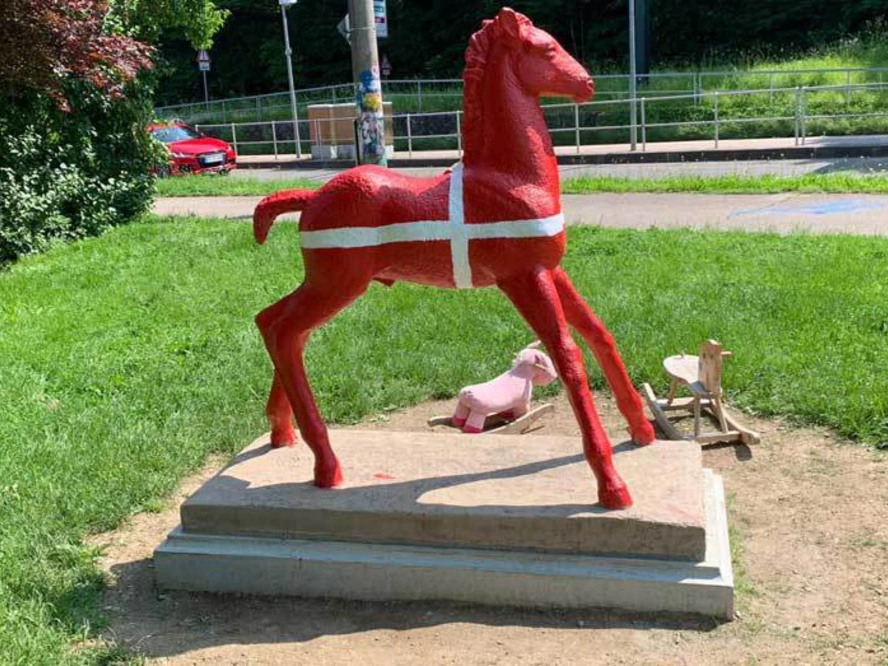
The Holbein Horse was erected in 1936 as a traffic marker. Designed by sculptor Werner Gürtner, it was intended to guide and regulate traffic at an intersection.
Today, the Holbein Horse is regularly and unofficially repainted. The city tolerates this practice. Political statements, humor, acts of remembrance, or local events are reflected in its changing appearances, making the object a living part of urban culture.
There is no official permission to paint it – and yet the Holbein Horse is considered one of Freiburg’s most widely accepted “illegal” artworks.
More about the history of this place
The Holbein Horse shows how the meaning of an object in public space can change over time. What began in 1936 as a sober traffic marker gradually lost its original function, but remained present in the cityscape.
Already after the Second World War, unknown individuals began repainting the concrete horse again and again. What was once a purely functional structure became a carrier of changing messages. Without a museum, information board, or protective glass, the Holbein Horse has remained part of everyday life to this day. Its story is not explained, but continually rewritten – by those who transform it.